March 6, 2026·7 min read
How Plauen lace is made
The creation of a single piece of Plauen lace is a sequence of distinct stages, each demanding its own form of expertise. It is a process that has remained fundamentally unchanged since the late nineteenth century, not because of nostalgia, but because no alternative has been found that produces equivalent results. The union of machine precision and manual care is what gives Plauener Spitze its singular character.
The pattern drawing
Every piece begins with a pattern. In the workshops of the Vogtland, the pattern is not a digital file or a photographic reproduction. It is a hand-drawn design, rendered at the exact scale of the finished piece, that maps the placement of every thread. The designer must account for the density of stitching in each area, the width and weight of thread to be used, and the negative spaces that will become the lace's transparency after the base fabric is dissolved.
Many patterns in active use today were drawn decades ago, some tracing back to the founding years of a family workshop. They are archived with care, stored flat in purpose-built drawers to prevent creasing. When a new pattern is needed, the designer works by hand, often spending weeks refining a single composition. The process requires not only artistic skill but a deep technical understanding of how thread behaves under tension, how stitch density affects the structural integrity of the finished lace, and how the dissolving process will alter the appearance of the embroidered surface.
The Schiffchen shuttle loom
The embroidery is carried out on the Schiffchen machine, a specialized loom that has been the workhorse of Plauen lace production since the 1850s. The name refers to the shuttle, a small boat-shaped device that carries the bobbin thread back and forth across the base fabric as the needle thread is fed from above.
The base fabric itself is critical. It must be strong enough to hold its shape under the tension of embroidery, yet susceptible to the chemical bath that will dissolve it later. Historically, the base was a cotton organdy; modern workshops may use water-soluble fabrics that dissolve in warm water rather than requiring caustic chemicals. The choice of base fabric affects the texture and hand of the finished lace.
Operating the Schiffchen machine is skilled work. The operator must set thread tension precisely, monitor stitch formation continuously, and manage color changes across complex multicolored designs. A machine may carry dozens of needles, each following the pattern simultaneously, but the operator's judgment governs the quality of every stitch. Misaligned tension, a broken thread, or an improperly loaded bobbin can ruin an entire panel. Apprentices typically train for years before they are trusted to operate the machines independently.
The dissolving bath
Once the embroidery is complete, the fabric panel enters the dissolving bath. For traditional chemical-lace production, this involves a caustic solution that breaks down the base fabric's fibers while leaving the embroidery threads intact. The process must be timed carefully: too brief, and remnants of the base fabric remain; too long, and the embroidery threads themselves may be weakened.
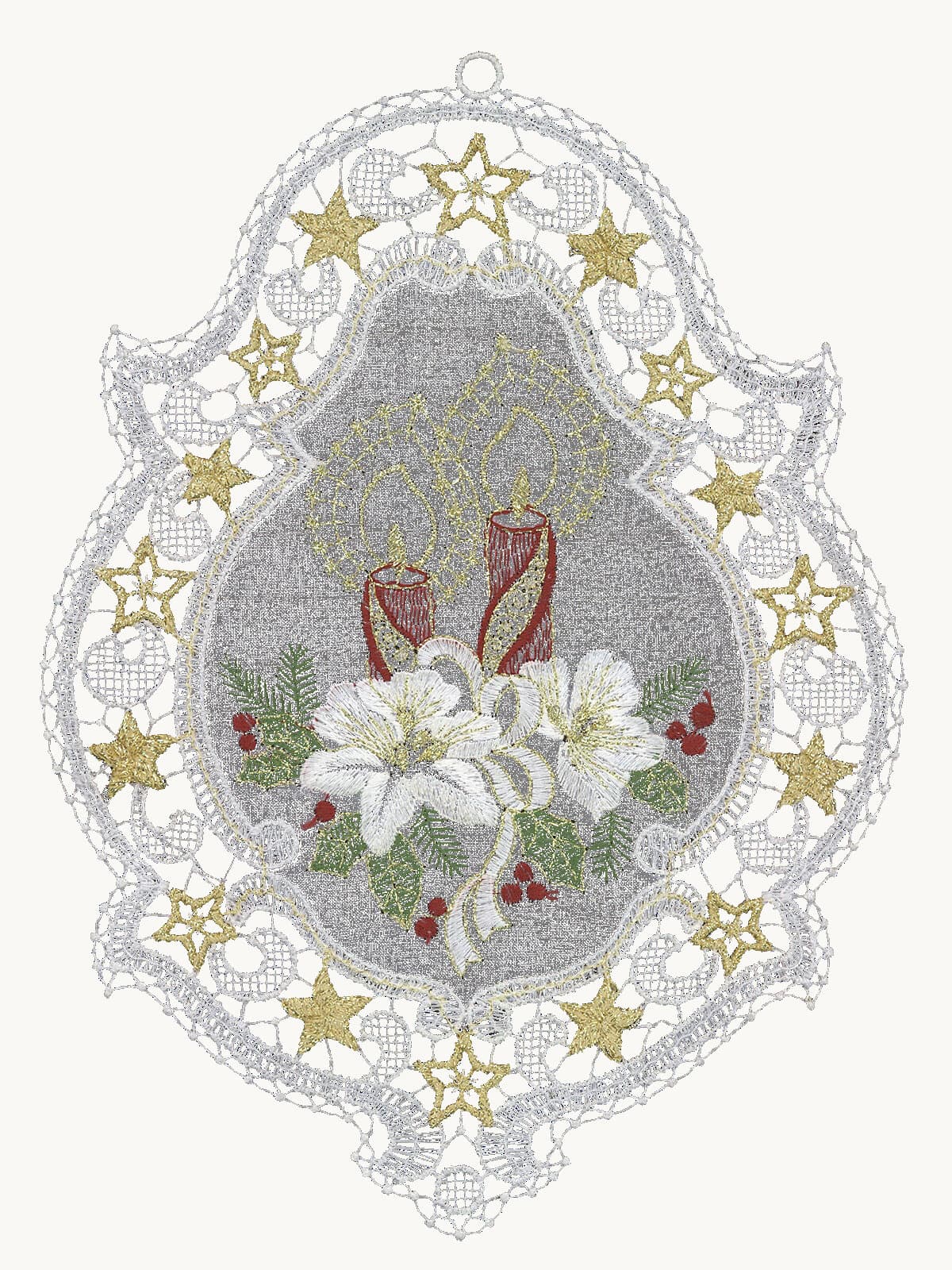
What emerges from the bath is the lace itself, a freestanding structure of interlocking stitches with no backing. The open areas between embroidered motifs become transparent, capable of transmitting light in ways that no woven or printed textile can achieve. This quality is what makes Plauen lace window pictures so distinctive: the interplay between thread and light creates an image that changes character throughout the day.
The dissolved lace is rinsed thoroughly to remove all chemical residue, then laid flat to begin the drying process. At this stage the lace is fragile and must be handled with extreme care.
Hand-finishing
The work that follows the dissolving bath is entirely manual, and it is here that the character of each piece is finalized. The damp lace is stretched and shaped on a flat surface, its edges aligned, its motifs positioned precisely. Excess threads, remnants of the dissolving process, loose ends from color changes, are trimmed with small, sharp scissors.
Starching follows. The degree of starch applied depends on the intended use of the piece. A window picture, which must hang flat against a pane of glass, receives a firm starching that gives it body and rigidity. A tablecloth or runner receives a lighter treatment, enough to give the lace crispness without sacrificing drape. The starch solution is applied evenly, often by hand using a brush or spray, and the piece is shaped into its final form while still damp.
The last stage is inspection. Experienced finishers examine every piece against a light source, checking for broken threads, uneven stitch density, discoloration, and structural weaknesses. The standard is absolute. A piece that does not meet the workshop's criteria is reworked or discarded, regardless of the time invested. This uncompromising approach to quality control is what sustains the reputation of authentic Plauener Spitze.
The thread itself
The threads used in Plauen lace are predominantly fine cotton and viscose, selected for their tensile strength, their sheen under natural light, and their capacity to hold shape after starching. Some pieces incorporate metallic threads, particularly gold and silver, for decorative accents in Christmas window pictures and seasonal ornaments. The choice of thread weight and composition is part of the designer's original specification and directly affects the visual density and tactile quality of the finished lace.
Continue reading

March 20, 2026·7 min read
The Plauener Spitze tradition
Five centuries of lace-making in Saxony's Vogtland region, from the earliest hand-worked threads to the refined embroidery that defines Plauen lace today.
February 18, 2026·6 min read
Otto Dotzauer and Stickerei Vogel
The last families preserving the craft of Plauener Spitze. How two Vogtland workshops carry a tradition that once employed tens of thousands.